Thursday, November 18, 2010

Santa Cruz Real Estate and Community News

Walter Stauss Real Estate and Community News • Cell: 831.246.4663 • Email: walter@831.com
To ensure you continue to receive emails from me, please add walter@831.com to your address book today.
Walter Stauss Banner

NOVEMBER 2010

QUICK LINKS: Market statistics, charts, graphs | Search Listings | Newsletter | My Blog
Dried Flower & Succulent Wreath Sale at UCSC's Arboretum

Saturday, November 20, 10am - 4pm.
Sunday, November 21, 10am - 2pm.

The popular annual sale of hand-made, one-of-a-kind wreaths and other decorations for the holidays is a lovely way to gently usher in the holidays and participate in a very important fundraiser for the Arboretum. Bring a friend. Rain or Shine!

Plants (excluding cacti and succulents) will be 25% off during the Dried Flower and Succulent Sale Nov. 20 and 21. No special coupon is necessary. Just come to Norrie's Gift Shop 10am to 4pm either Saturday or Sunday, Nov. 20 and 21, and select from a lovely array of plants. Fall is a terrific time to plant, so you can let the winter rains water your plants!

Market Stats

Our local market continues to be confused, at least according to the stats (from Oct 09 to Oct 10):

  Oct 2010 Previous Month Year-over Year
Median Price $513,873 $535,000 (-3.9%) $515,000 (-0.2%)
Average Price $572,392 $680,397 (-15.9%) $563,652 (+1.6%)
No. of Sales 112 139 (-19.4%) 180 (-37.8%)
Pending Properties 298 270 (+10.4%) 316 (-5.7%)
Active 748 821 (-8.9%) 795 (-5.9%)
Sale vs. List Price 96.0% 97.3% (-1.4%) 98.8% (-2.9%)
Days on Market 67 84 (-19.6%) 79 (-14.2%)

Call me if you're thinking about buying or selling and we can discuss the market and timing (cell: 831.246.4663). Read the entire newsletter online here.

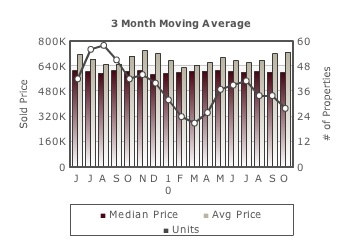
Prices and Sales, Single-Family Residences, Santa Cruz:
Sales, City of Santa Cruz

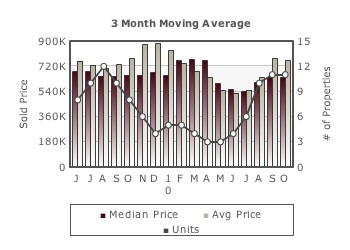
Prices and Sales, Single-Family Residences, Aptos:
Sales, Aptos

5 Foreclosure Myths

Foreclosures reign as one of today's top real estate trends. Homebuyers are looking for your guidance when it comes to dealing with this largely misunderstood process. Whether a buyer is holding out for "shadow inventory" or looking for an exceptional deal, you can help dispel myths and eliminate foreclosure confusion. Read these top 5 foreclosure myths, and make smarter real estate decisions in today's market.
Read more >


California pulls ahead of Florida in the race to recovery

As California begins the slow crawl back to economic stability, Florida remains stuck in the swampland of the economic downturn. The similar circumstances of the two states at the height of the Great Recession leave many questioning what differences led to a swifter recovery pace in the West. The more efficient foreclosure process in the Golden State is the key.
Read more >


HUD to Launch Pilot Program to Help Homeowners

HUD has announced a new pilot program that will offer credit-worthy borrowers low-cost loans to make energy-saving improvements to their homes. .
Read more >


Mortgage Rates Continue Record Slide

Freddie Mac reports that rates on fixed mortgages again fell to their lowest levels in decades this past week, with the average interest on 15-year loans dipping to 3.57 percent from 3.63 percent a week earlier, and the average interest for 30-year loans sliding to 4.17 percent from 4.24 percent. That is the lowest since 1971. The impact of the favorable borrowing costs is being muted somewhat, however, by a high rate of joblessness, foreclosures, and tight credit. Source: Boston Globe (11/12/10)


The information in this e-mail is provided solely for informational and/or entertainment purposes. If your property is listed with another real estate company or if you have a buyer's agency agreement with an agent, please disregard this offer. It is not my intention to solicit the offerings of other real estate brokers. I disclaim any warranties or representations concerning the information contained in this email. I do not guarantee the accuracy of the information contained in this e-mail and instruct you to independently verify the accuracy of the information provided. All intellectual property rights are retained by their owners.


Click to view this email in a browser

If you no longer wish to receive these emails, please reply to this message with "Unsubscribe" in the subject line or simply click on the following link: Unsubscribe

Click here to forward this email to a friend

Walter Stauss / Lifestyles Real Estate
500 Seabright Avenue
Santa Cruz, California 95062

Read the VerticalResponse marketing policy.

Try Email Marketing with VerticalResponse!

HUD to Launch Pilot Program to Help Homeowners

RISMEDIA, November 10, 2010--HUD has announced a new pilot program that will offer credit-worthy borrowers low-cost loans to make energy-saving improvements to their homes. Backed by the Federal Housing Administration (FHA), these new FHA PowerSaver loans will offer homeowners up to $25,000 to make energy-efficient improvements of their choice, including the installation of insulation, duct sealing, doors and windows, HVAC systems, water heaters, solar panels, and geothermal systems.

HUD and FHA developed PowerSaver as part of the Recovery Through Retrofit initiative launched in May 2009. More homeowners are interested in making their homes energy efficient, according to industry forecasts. Yet options are still limited for financing home energy improvements, especially for the many homeowners who are unable to take out a home equity loan or access an affordable consumer loan. HUD today published a notice seeking the participation of a limited number of mortgage lenders in the two-year pilot program slated to begin in early 2011.

“PowerSaver provides lenders with a new product option to serve a potentially growing market,” said David H. Stevens, FHA Commissioner. “We believe there are a number of lenders who will be interested in working with us to help save energy and money for homeowners, while creating jobs and cutting greenhouse gas emissions.”

Lenders will be selected to participate in the PowerSaver pilot based on their capacity and commitment to provide affordable home energy improvement financing. Lenders will be required to serve communities that have already taken affirmative steps to expand home energy improvements. HUD will help lenders identify such markets – which exist in many suburban, rural and urban areas across the country.

PowerSaver loans will be backed by the FHA – but with significant “skin in the game” from private lenders. FHA mortgage insurance will cover up to 90 percent of the loan amount in the event of default. Lenders will retain the remaining risk on each loan, incentivizing responsible underwriting and lending standards. FHA will provide streamlined insurance claims payment procedures on PowerSaver loans. In addition, lenders may be eligible for incentive grant payments from FHA to enhance benefits to borrowers, such as lowering interest rates.

PowerSaver has been carefully designed to meet a need in the marketplace for borrowers who have the ability and motivation to take on modest additional debt to realize the savings over time from a home energy improvement. PowerSaver loans are only available to borrowers with good credit, manageable overall debt and at least some equity in their home (maximum 100% combined loan to value).


For More InformationPlease contact me if you'd like more information about our community or real estate market:

Walter Stauss, Lifestyles Real Estate500 Seabright Avenue, Santa Cruz, California 95062Cell: 831.246.4663, Email: walter@831.com, Web: http://www.831.com DRE #01105052

California pulls ahead of Florida in the race to recovery

As California begins the slow crawl back to economic stability, Florida remains stuck in the swampland of the economic downturn. The similar circumstances of the two states at the height of the Great Recession leave many questioning what differences led to a swifter recovery pace in the West. The more efficient foreclosure process in the Golden State is the key.

California completes the vast majority of its foreclosures through a nonjudicial foreclosure process, also known as trustee’s sales, and thus does not require foreclosures to be approved by a judge, as is the case in Florida. While court involvement may be helpful to those homeowners who didn’t fully understand the risk involved in the mortgage they acquired, the process is much more tedious and time consuming.

A faster method of clearing out foreclosures along with a more dynamic economy has provided California with the means to an upturn before Florida. Home prices in Los Angeles are up 10% from their bottom, San Diego is up 14% and San Francisco up 21%. Miami prices are up a measly 2% from their all-time low, and Tampa prices are still falling.

first tuesday take: Florida is to California what California is to the recovery which could be taking place, if lenders would either process their backlog of foreclosures, or acquiesce to forgiving principal indebtedness, i.e., cramming down loan balances for underwater homeowners. Just as judicial foreclosures extend Florida’s economic recovery in comparison to California’s economic recovery, lender foot-dragging extends California’s recovery.

For economic recovery to speed up, lenders need to quit refusing cramdowns and delaying foreclosures in hopes of retaining their solvency. California may be more efficient than other states, but that isn’t saying much. The process is certainly not without its blemishes, the biggest being lenders’ lack of participation in the effort to save our California economy and keep homeowners in their homes, something they will have no small interest in going forward when they will want to be everyone’s financial partner.

An efficient system for addressing delinquency is necessary, but not at the expense of fairness. Rather than halting foreclosure altogether, we must re-examine the laws governing lender oversight and fight for stricter legal recourse when lenders refuse to foreclose or borrowers experience unfair foreclosures in the future. After all, it is the owner who defaults and by doing so exercises his put option to require the lender to take the property, and nothing else.


For More InformationPlease contact me if you'd like more information about our community or real estate market:

Walter Stauss, Lifestyles Real Estate500 Seabright Avenue, Santa Cruz, California 95062Cell: 831.246.4663, Email: walter@831.com, Web: http://www.831.com DRE #01105052
5 Foreclosure Myths

Four years into the housing crisis, myths about foreclosure still litter the minds of even the smartest of real estate consumers. When it comes to matters as high stakes as your home, confusion can cost you thousands - or even your home. Whether you’re a buyer looking at foreclosures, a homeowner struggling to keep your home or a seller concerned making sure your home can compete with the foreclosed homes on your block, these foreclosure myths are prime for the busting, with no further ado.

Myth #1: Foreclosure happens fast. With unemployment and underemployment still affecting nearly 1 in every 4 Americans, no one is immune from fears that a pink slip might quickly turn into a foreclosure notice. According to NeighborWorks America, nearly 60 percent of families seeking foreclosure counseling cited a lost job or cut wages as the reason they were facing foreclosure.

While the Obama Administration's Home Affordable Programs haven't been nearly as effective as predicted in actually preventing foreclosures, they have had the effect of extending the foreclosure process for many families. Even though the legal process of foreclosure can happen in as few as 6 months in most states, it is currently taking much longer for the average foreclosure to get to completion. Recently, JP Morgan Chase revealed that their average borrower who loses a home to foreclosure has not made any payments in 14 months nationwide; 22 months in FLorida and 26 months in New York.

To be sure, some see this as a good, others view it as unnecessarily dragging out the overall market's recovery. Many insiders will point out that these delays in foreclosure may be calculated to save the banks the costs of owning and maintaining foreclosed homes, not to help homeowners. In any event, the fact that foreclosure does not happen nearly as fast, in many cases, as expected does give families who are temporarily down on their luck some extra time to try to get back on their feet and save their homes.

Myth #2: Buyers can’t get clear title or title insurance on foreclosed homes. When the foreclosure robo-signing scandal first hit, there was widespread concern that buyers would not be able to get clear title on foreclosed homes, because the former foreclosed owners might be able to come get their homes back when the improprieties in the bank's foreclosure documentation processes came fully to light. At the same time, several of the country's largest title insurance companies publicly balked at issuing policies on bank-owned homes until the issue was resolved. At this point, the banks claim they have revamped their processes, and all banks have stated that they have found not a single borrower whose home was repossessed without them having missed the requisite number of mortgage payments. Nevertheless, a number of governmental investigations are still in progress.

The fact is, buyers of bank-owned properties in nearly every jurisdiction are protected from later title attacks by foreclosed homeowners by the bona fide purchaser rule, under which courts would prefer to simply award cash damages to be paid by the culpable bank to a wrongfully foreclosed-on homeowner, rather than reversing the sale or ownership to the new, innocent buyer. Additionally, the title insurers have now changed their tune and restarted issuing insurance policies on bank-owned homes which protect buyers' interests, after working with the banks for them to take responsibility in the event a former homeowner prevails in a wrongful foreclosure suit.

While there are still many intricacies of title to be resolved for foreclosure buyers who purchase homes at trustee sales and auctions, or for cash buyers who often went without title insurance in the past, on the average, Trulia-listed, bank-owned property purchased with an average mortgage and title insurance, the chances a buyer's title will later be successfully challenged by the foreclosed homeowner on the basis of robo-signing? Exceedingly slim.

Myth #3: Buyers should wait for the shadow inventory to be released. Many a buyer, discouraged with the homes they see on the the form in their price range, has decided to sit still and wait for the banks to release for sale what is called their "shadow inventory" - rumored to be anywhere from 4 to nearly 6 million homes that have already been foreclosed, but not listed for sale, or will be foreclosed in the near future. The fact is, to the extent that the banks have acknowledged the existence of a pool of homes they own but are not selling, they have expressed that their reasoning for holding the homes off the market is to avoid flooding the market and driving home values down any further. For that reason, buyers should not expect to see a massive influx of these shadow homes onto the market anytime soon - if ever.

The banks' current modus operandi is that as they sell a home, the replace it with another home in that market - if they sell 50 homes in a town that month, they'll put another 50 on the next. So, don't hold your breath waiting for a fabulous new flood of homes. Instead, set up a Trulia alert to notify you when homes that fit your search criteria come on the market, and be ready to call your agent and go visit any and every one that looks like it might be a good fit.

Myth #4: If you’re looking for a deal, you’re looking for a foreclosure. Despite what they may say, no buyer’s heart's fondest desire is to buy a foreclosure. But almost every buyer dreams of buying a great home - and getting a great deal on it. Many people think that to get a great value on their home on today's market, it means they must buy a foreclosure. As a result, the value and other advantages of buying an individually-owned home on today's market are frequently overlooked. Individual sellers with homes on the market right now are generally quite motivated, and understand that their homes are competing with discounted short sales and foreclosed homes. Many of these sellers are slashing prices in an effort to get them sold - the most recent Trulia Price Reduction Report revealed that 27 percent of homes on the market across the country have had at least one price reduction. Now that's what I call a sale!

Further, individual owners are often much more negotiable on a wide range of contract terms than a bank which owns a foreclosed home. You can work with non-bank owners on things like repairs, closing dates, choice of escrow provider, closing costs and even included personal property much more flexibly than you can when the bank is on the other side of the bargaining table. On top of that, many individually-owned homes are in pristine, move-in condition; that is much rarer with foreclosures. So, don't underestimate the value of the deal you might be able to get on a non-foreclosed home. Just get clear on what you can afford and look at all the homes that are available in that price range, without discriminating against non-foreclosures.

Myth #5: Having a foreclosure on your credit history means it'll take years and years before you can buy again. One of the most Frequently Asked Questions in the Trulia Voices Community by homeowners who are facing or have just lost a home through foreclosure is how long it will take before they'll be able to buy again. Until recently, the standard wisdom was that 5 years, minimum, would have to have elapsed between the foreclosure and the new home purchase. Now, though, borrowers can obtain an FHA loan with the low, 3.5 minimum down payment requirement as soon as 3 years following a foreclosure. To do so, though, all your other ducks must be in a row.

Post-foreclosure buyers need a credit score of 620-640 to qualify for an FHA loan; higher for a non-FHA loan - given that the foreclosure itself usually dings anywhere from 100-150 points off the credit score (not necessarily counting a full year or more of pre-foreclosure missed payments), former homeowners who want to buy again need to ensure they have no other late payments or credit dings after they lose thier home. You must have clean credit with no derogatory marks like late credit card payments following the foreclosure, and you may also be required to document 12 to 24 months straight of on-time rent payments after the foreclosure.

Further, the bank may impose a lower debt-to-income ratio on post-foreclosure borrowers than on borrowers who have not had a foreclosure, in an effort to keep your mortgage payments low, keep you from overextending yourself and boost the chances you'll be a successful homeowner over the long-term this time around. The bank will also need to see 2 years of continuous employment history in the same field, and documentation that you meet other loan qualification requirements.


For More InformationPlease contact me if you'd like more information about our community or real estate market:

Walter Stauss, Lifestyles Real Estate500 Seabright Avenue, Santa Cruz, California 95062Cell: 831.246.4663, Email: walter@831.com, Web: http://www.831.com DRE #01105052